

Private drivers: best for sightseeing without driving yourself
A private driver is the best way to get around Bali without a scooter when your sightseeing day includes several stops and you want someone else handling both the driving and the pickups. For anyone researching “bali transport without scooter,” the deciding factor is not simply distance: it is whether you need transport to stay available while you explore.
Private driver hire means booking a vehicle and driver for an agreed itinerary or period. Confirm that the arrangement includes waiting between stops, rather than assuming every quote buys you the same service.
Choose this option for a day built around visits, meals and time on foot—not because you expect a driver to make an overfilled itinerary work. You hand over the driving, but you still need to choose priorities and agree on a realistic route.
Judge the booking on the itinerary, inclusions and flexibility—not the headline quote alone. A price means little until you know where the driver will take you, how long they will remain available and what happens if your plans change.
Before committing, send the provider your accommodation address, proposed stops and preferred return time. Ask for written answers to these questions:
- What does the quote cover? Confirm the vehicle, driver, fuel, parking, tolls and any waiting charges. Ask which expenses you must pay separately.
- When does the booking start and finish? Establish whether the agreed period runs from your pickup until your return, and how any extra time is charged.
- Which stops are included? Name the places you actually want to visit. Ask whether changing the route affects the price, and make clear whether you want shopping stops.
- What vehicle will arrive? Give the passenger count and luggage requirements. If you need a child seat or have mobility needs, request specific confirmation rather than relying on “suitable vehicle.”
- How will pickups work? Agree on a contact method and meeting point after each visit. Ask what happens if the booked driver or vehicle becomes unavailable.
Bali’s official visitor guidance tells tourists to rent vehicles from legal companies. Treat that as a reason to check who is taking your booking: request the operator’s business details, a written booking confirmation and cancellation terms before paying.
For the itinerary itself, separate must-see stops from optional ones. Ask the driver to review the route before you book, including time for meals and walking around—not just time spent in the vehicle.
For example, if one visit runs longer than expected, decide whether you would rather drop an optional stop or pay for additional time, subject to the driver’s availability. Making that choice beforehand is better than negotiating it when you are already late.
The trade-off is straightforward: you are reserving someone’s availability, including time when you are not moving. That makes private drivers a strong fit for multi-stop sightseeing, but a less compelling choice when most of your day will be spent at one place.
Finally, do not confuse a driver with a tour guide. If you want historical explanations, guided visits or a particular language, ask whether those services are included. Book the service you need, not the one you hope the word “private” implies.
Cars 4 Rent Bali: best for travelers who want self-drive independence
Cars 4 Rent Bali is best considered by travelers who want to drive themselves, control their departure times, and keep responsibility for the journey rather than hand it to someone else.
Self-drive means renting a car without a driver: you choose the route, make the stops, and handle the driving and parking. For getting around Bali without a scooter, that independence is the main reason to consider it—not an assumption that driving will always be quicker or easier.
Start with three selection criteria: whether you can legally drive in Indonesia, whether you feel comfortable driving on the left, and whether your accommodation and planned stops have suitable parking. A rental makes less sense if any of those remains unresolved, however appealing an open-ended itinerary looks.
Independence comes with the driving job
A self-drive car lets you change plans without arranging each journey separately. You can leave when you are ready, carry your belongings between stops, and decide to head back early without coordinating another pickup.
But the car does not remove the work of navigating, finding parking, or assessing an unfamiliar road. Plan around places you can realistically reach and park at, rather than treating every pin on a map as an easy addition to the day.
Indonesia’s traffic law requires road users to keep to the left, with the right side used for overtaking or when directed by police (Law No. 22 of 2009, Article 108). If that differs from driving at home, factor the adjustment into your decision before committing.
What to confirm before booking
Choose the provider on clear terms, not just an attractive headline rate. Bali’s official visitor guidance specifically tells tourists to rent vehicles from legal companies, so ask for the contracting business’s identity and written rental terms.
Before confirming a booking with Cars 4 Rent Bali, use this checklist:
- Check your documents. Confirm which licence and supporting documents apply to your circumstances in Indonesia. Resolve this before paying, rather than assuming that holding a licence at home settles the question.
- Request the full cost. Ask about the rental period, deposit, fuel policy, collection and return arrangements, late returns, and any additional charges.
- Read the damage terms. Ask what cover applies, what exclusions remain, and what you would owe after damage or theft. Do not treat “insurance included” as a complete explanation.
- Inspect the vehicle at handover. Record existing marks, check that lights and wipers work, and confirm how to report a fault or incident.
- Check practical fit. Confirm passenger and luggage space, then ask your accommodation about parking and vehicle access.
These are questions to settle in writing, not benefits to assume. For a closer look at the decision itself, use the guide to whether renting a car in Bali without a driver is right for you.
Self-drive earns its place when control over your schedule matters enough to justify taking on the driving. If you are comfortable with that trade-off, assess Cars 4 Rent Bali against the documents, vehicle suitability, and rental terms your actual itinerary requires.
Taxis and on-demand car services: best for occasional point-to-point trips
Taxis and on-demand car services work best for occasional trips between specific addresses, provided you check the fare basis, pickup point and return options before committing.
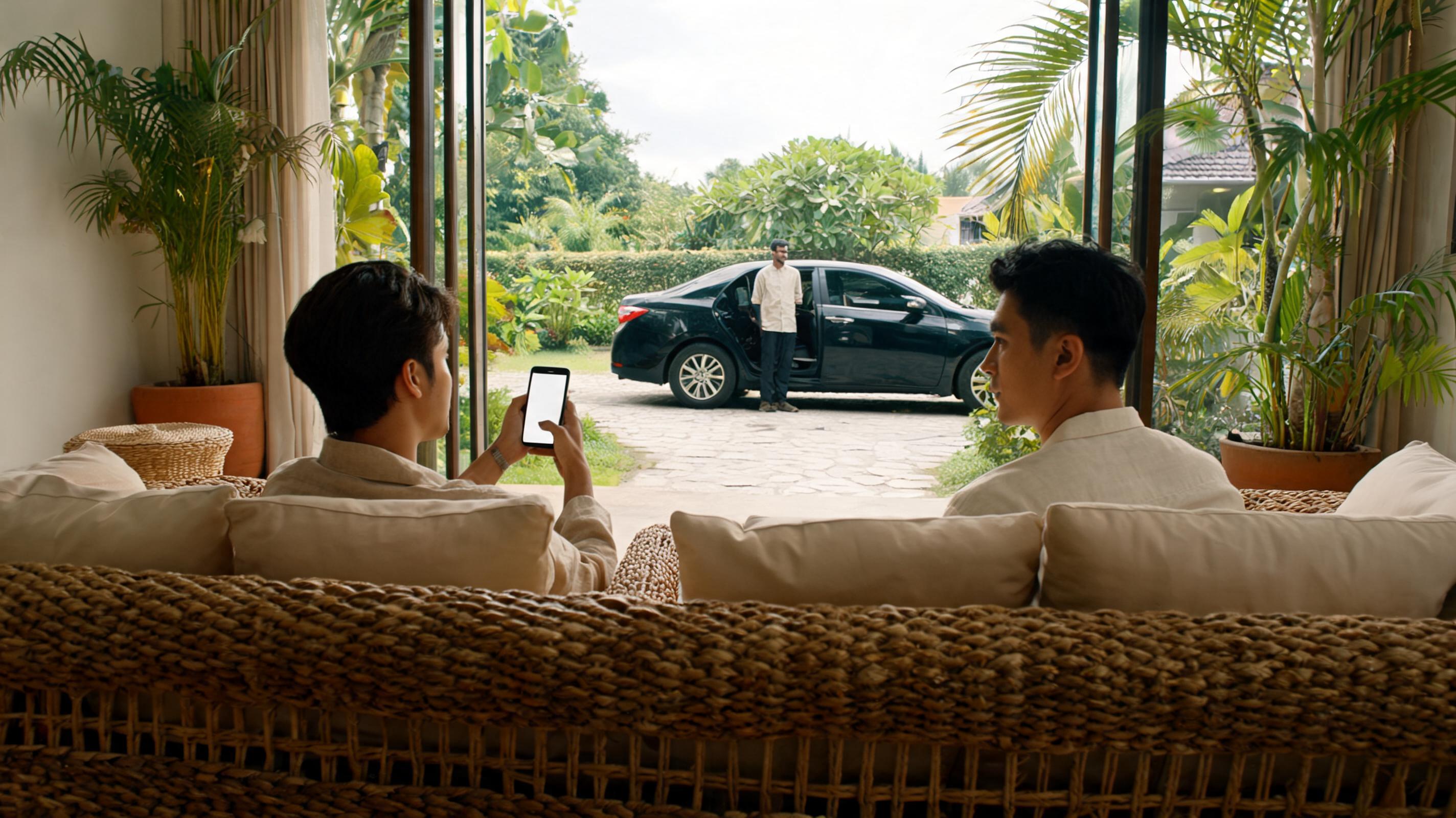
Choose this option when you need a ride to dinner, a shop or an appointment—not a vehicle that stays with you throughout the day. For getting around Bali without a scooter, it keeps the decision simple: arrange the journey you need, then leave the driving and parking to someone else.
The trade-off is that each new journey needs its own arrangement. A straightforward outbound ride does not establish that you can easily book the return, particularly if your destination is somewhere unfamiliar.
Know what you are agreeing to pay for. A metered taxi calculates the fare using its meter; a quoted ride gives you a price to accept before departure. With an on-demand booking, read whether the displayed amount is an estimate or an agreed fare, and check how the service handles waiting, route changes and additional stops.
Do not assume that “taxi” describes one universal pricing system. Before you get in, establish whether the driver will use the meter or whether you are accepting a fixed quote.
A useful booking check takes less effort than sorting out a misunderstanding afterwards:
- Confirm the exact destination. Use the accommodation or venue name alongside its address or map pin. Check that the pin marks the entrance you actually need.
- Confirm the pickup point. Ask where the car can stop, rather than assuming the driver can collect you at the door.
- Check the fare basis and extras. Ask whether parking, tolls or waiting would be additional, and whether a requested stop changes the price.
- Match the car to the trip. State your passenger and luggage requirements before accepting. If you need a child seat or accessible boarding, confirm the arrangement rather than treating a car booking as confirmation.
- Think through the return. Check how you will request another ride and keep your destination details available for the journey back.
Judge convenience door to door, not just by the quoted fare. A cheaper ride is less useful if its meeting point is difficult for you to reach. Likewise, a quick booking is not necessarily a quick arrival: leave room in your plans for the car to reach you and complete the journey.
Keep the service and vehicle details available, and verify that the arriving car matches your booking where those details are supplied. For a verbally arranged ride, settle the destination and payment basis before departure—not halfway there.
There is also a misleading price reference worth avoiding. A Bali government regulation lists Rp159,000 per person per trip as an airport taxi/transport cost allowance; that administrative figure should not be read as a universal customer taxi fare (source). Base your decision on the terms of the actual ride you are arranging.
For an evening out, this approach can be refreshingly uncomplicated: confirm the restaurant entrance, agree the ride terms and decide how you will get back. Once your plan involves repeated stops or a driver waiting between visits, check those arrangements explicitly; a point-to-point booking should not be assumed to include them.
Prebooked transfers: best for airport arrivals and hotel changes
Prebooked transfers are best for airport arrivals and hotel changes when you want the pickup, destination, luggage space and price agreed before you travel.
A transfer is a journey arranged in advance between specified locations. For getting around Bali without a scooter, it solves a narrow but important problem: moving yourself and your bags without having to organise the ride at the moment you need it.
Choose this option when your destination is settled and coordination matters more than flexibility. The booking should remove uncertainty—not leave you searching through messages outside arrivals.
Agree on the pickup, not just the destination
“Airport pickup included” is not a complete arrangement. Before paying for a Bali airport transfer service, get written confirmation of where you will meet, how you will identify the driver and whom to contact if you cannot find each other.
Send your flight details as well as your scheduled arrival time. Ask whether the provider tracks flight changes, when the waiting period starts and what happens if immigration or baggage collection takes longer than expected. Do not assume any of those services come with the booking.
Keep the confirmation and contact details accessible offline. A clear meeting instruction is more useful on arrival than a booking receipt that only says “Bali airport.”
Check the full journey price and luggage fit
Compare quotes for the same trip. Give each provider the exact accommodation address, passenger count and luggage details; a place name alone leaves too much room for misunderstanding.
Before you commit, check:
- Price basis: Is the quote for the whole vehicle or each passenger?
- Included charges: Does it cover airport parking, applicable road charges and any late-arrival surcharge?
- Waiting terms: How much waiting is included, and what triggers an additional charge?
- Vehicle space: Will everyone and their bags fit without putting luggage on passenger seats?
- Special requirements: If you need a child seat or room for bulky equipment, can the provider confirm the arrangement?
- Changes and cancellations: What happens if your flight changes or you move your hotel booking?
A government allowance is not a retail quote. Bali’s published airport transport cost table lists Rp159,000 per person per trip as an allowance; it does not establish what a particular transfer provider will charge for your journey (source). Use the provider’s written, journey-specific quote to make your decision.
Book hotel changes around access and checkout
For an accommodation move, share both properties’ names, full addresses and map pins. Ask the receiving property where a vehicle should stop, especially if the final approach is unclear, then pass that instruction to the transfer provider.
Set the pickup around checkout and agree on what happens if your next room is not ready. Confirm luggage storage with the property rather than assuming the driver can wait while you resolve it.
If you want a stop along the way, request it before booking. A direct transfer does not automatically include sightseeing, shopping or an open-ended lunch break; adding those changes the scope and potentially the price.
The trade-off is commitment. A prebooked transfer works well for a defined journey, but less well when you have not decided where to go or when to leave. Pay for a clear arrangement, not an implied promise of unlimited flexibility.
Trans Sarbagita buses: best for budget trips that fit the routes
Trans Sarbagita buses are best for budget trips in Bali when the operating route, stops and return service match your plans. Choose them by checking the journey first—not simply by spotting a low fare.

Bali’s 2024 provincial tariff regulation lists the Trans Sarbagita general passenger fare as Rp4,400, with student and disability/senior fares listed at Rp2,000 (official tariff table). That gives you a useful price reference, but confirm the current fare, payment method and any concession requirements before boarding.
For getting around Bali without a scooter, the important distinction is fixed-route transport versus door-to-door transport. A bus serves designated stops; your accommodation and destination may sit some distance from them. The fare matters, but so does everything required to reach the bus and finish the journey.
Check the whole trip before committing:
- Confirm the operating route. Check that the service you intend to use currently runs and serves your destination. A route shown on an old map is not enough to plan a day around.
- Find the exact boarding and exit stops. Use specific stop locations rather than assuming a bus passes somewhere convenient within a neighbourhood. Check which direction you need before waiting.
- Inspect the walking legs. Look at the route from your accommodation to the stop and from the exit stop to your destination. Consider road crossings, pavement conditions, heat, rain and whatever you will carry.
- Check the return separately. Confirm where to board for the journey back and when the relevant service finishes. Do not assume the return stop sits directly opposite your arrival stop.
- Verify payment and allow waiting time. Establish how to pay before you travel, and leave room in your plans for a missed departure. Avoid building a time-critical appointment around an unverified timetable.
A straightforward outing is the strongest use case: your starting point is near a confirmed stop, your destination is near another, and you can be flexible about arrival. A single destination also makes the planning worthwhile because you only need to understand the outward and return journeys.
A scattered sightseeing day is a different proposition. Each extra stop introduces another route check, walk or wait, so a cheap individual ride does not automatically make the entire itinerary practical. Assess the day you actually want, rather than rearranging every activity to defend the transport choice.
The same logic applies to luggage and mobility needs. If you cannot comfortably manage the walking portions, confirm the access arrangements you need before treating the bus as a workable option. A concession fare alone tells you nothing about whether a particular stop or journey suits you.
You do not need to make public transport in Bali an all-or-nothing decision. Use Trans Sarbagita for the journeys that fit its confirmed routes, and make separate arrangements for those that do not. The useful saving is a low-cost trip you can complete comfortably—not merely the lowest fare on paper.
FAQ
Can I get around Bali without renting a scooter?
Yes. You can combine private drivers, self-drive car rentals, taxis, prebooked transfers and buses. Choose according to your itinerary rather than expecting one option to suit every journey.
Should I hire a private driver or rent a car in Bali?
Hire a private driver if you want sightseeing flexibility without handling the driving. Consider a self-drive rental if you value independence, have the required driving documents and are comfortable navigating local roads.
How much does it cost to hire a driver in Bali?
Request a quote for your specific itinerary, passenger count and service hours. Confirm whether waiting, parking, tolls and overtime are included so you can compare providers fairly.
What should I check before booking a self-drive car in Bali?
Check the company's legitimacy, required driving documents, insurance terms, excess, deposit and breakdown arrangements. Record the vehicle's condition at handover and get the rental terms in writing.
Can I rely on buses for my whole Bali trip?
Only if the current routes and operating hours fit your plans. Check each journey in advance and budget for another transport option where stops are inconvenient or service does not cover your destination.


