

The short answer: budget by route and booking type
A Bali taxi cost estimate is only useful when it matches both your actual route and the way you book: a short local ride, an airport pickup and a prearranged private transfer are different budgeting items. Budget for each journey separately rather than applying one island-wide “average taxi fare” to your whole trip.
The useful starting point is not a headline price. It is a transport plan that separates getting to your accommodation from getting around after you arrive. This guide from Cars 4 Rent Bali uses that distinction to help you make a workable budget without treating unlike journeys as interchangeable.
Separate arrival transport from everyday rides
Treat your airport arrival as its own budget line. An airport-to-hotel journey has a defined purpose and destination; it should not become your benchmark for every taxi ride during the rest of your stay.
Keep departures separate, too. A return journey belongs in the budget even if you have not decided how you will book it. Otherwise, your transport estimate covers arriving in Bali but quietly leaves out leaving it.
For the days in between, organise your likely journeys into a few practical groups:
- Local outings: trips from your accommodation to a restaurant, beach or meeting, followed by a separate return journey.
- Accommodation changes: travel from one base to another, rather than an outing that ends where it started.
- Longer excursions: journeys where you need to decide whether you want transport to a destination or an arrangement covering the wider outing.
These are planning categories, not published fare bands. Their job is to stop a cheap local journey from becoming the assumed cost of every movement on your itinerary.
Keep booking types distinct
Record whether each estimate refers to a metered taxi or a prearranged transfer. Do not average the two together and call the result a typical fare: that removes information you need to make the booking decision.
Also distinguish a journey you have priced from one you have merely allowed money for. A provisional allowance keeps your trip budget moving; it is not evidence that a driver will accept that amount.
You do not need to price every spontaneous outing before travelling. Start with the journeys your itinerary already commits you to, then leave a separate allowance for optional rides. That gives you a usable answer to “How much should I budget?” without pretending that every visitor takes the same routes or books transport the same way.
How metered fares and prearranged transfer prices work
A metered fare prices the journey as it happens. A prearranged transfer prices an agreed journey before it starts. That distinction matters more than the label “taxi”: booking a vehicle in advance does not, by itself, mean you have booked a fixed-price ride.
When comparing Bali taxi cost, first identify what the quoted amount represents. A meter-based estimate, an agreed transfer price and a vehicle-with-driver booking are different arrangements, even when each gets you to the same destination.
Metered fares: the journey determines the charge
A taxi meter calculates a fare using its configured tariff, rather than a price negotiated for your particular destination. The calculation can include a starting charge, distance travelled and time spent waiting or moving slowly.
The important distinction is between an estimate and the meter reading. An estimate describes what the journey might cost; it does not replace the meter unless you explicitly agree to a different pricing arrangement.
For a metered journey, understand these basics:
- The destination defines the trip, not a fixed price. Naming your hotel does not automatically lock in the fare.
- The meter calculates the metered component. Do not assume a verbal estimate is a cap.
- The tariff matters. A meter is a calculation method, not evidence that every taxi charges the same rate.
This model suits a straightforward journey when you accept that the exact metered amount will emerge during the ride. It offers a visible calculation rather than advance certainty.
Prearranged transfers: the agreement determines the price
A prearranged transfer starts with a defined transport job: collection at an agreed place and a journey to an agreed destination. With a genuinely fixed-price transfer, the agreed price covers that specified service, subject to the booking terms.
“Prearranged” describes when you book. “Fixed-price” describes how you pay. Treating those words as interchangeable is where comparisons go wrong.
The unit being sold matters, too. A price per vehicle is not the same as a price per passenger, and a one-way transfer is not the same as keeping a driver available for further journeys. Neither arrangement is inherently better; they cover different jobs.
If you need a driver to remain available rather than simply drop you off, the next useful comparison is how a van-with-driver booking is priced in Bali.
The clean comparison is therefore metered journey versus agreed transport service, not simply taxi versus private car. Decide whether you want a fare calculated during the trip or a price attached to a defined booking. Then compare like with like.
Illustrative costs for common Bali journeys
A useful Bali taxi cost comparison starts with the journey, not a single island-wide average. An airport arrival, a local dinner trip and an outing to Ubud belong on separate budget lines: they cover different journeys and may use different booking arrangements.
The examples below show what each cost needs to cover. They are budgeting illustrations, not published tariffs or fixed-price offers.
Bali airport to Seminyak: budget for the arrival leg.
For an airport-to-Seminyak journey, the useful figure is the total for your travelling party to reach its accommodation—not a per-person amount unless the service explicitly charges that way. Keep this separate from the rest of your holiday transport budget.
If you also need transport back to the airport, give that departure journey its own line. Do not silently treat an arrival price as a return fare, or assume the departure will cost exactly the same.
Bali airport to Ubud: use a destination-specific amount.
An airport-to-Ubud taxi cost should stand on its own rather than borrowing a Seminyak allowance. The destination matters, and a price for one route does not establish the price for another.
For the budget, label this clearly as “airport to Ubud accommodation.” That keeps an arrival transfer distinct from any sightseeing you might want after checking in. A direct journey and an outing with stops are not the same purchase.
Accommodation to a restaurant: count the journey home.
A dinner-trip budget needs both the outward ride and the return. The amount paid to reach the restaurant represents only part of the evening’s transport spending.
Keep each leg visible rather than recording a single vague “taxi” allowance. This makes it easier to distinguish a costly individual journey from an ordinary expense repeated throughout a stay.
Seminyak to Ubud and back: separate transport from the outing.
For a return outing, distinguish separate point-to-point rides from an arrangement that includes a driver remaining available. These represent different scopes of service; an outbound fare alone does not describe the cost of the whole day.
Your working budget can stay simple:
- Arrival: airport to accommodation.
- Local travel: each planned outward and return journey.
- Cross-island outings: the complete transport arrangement.
- Departure: accommodation to airport.
Add the relevant journey amounts to those lines. The result is a trip-specific transport budget, rather than a headline fare stretched across journeys it never covered.
What can increase your final fare?
Your final Bali taxi cost can rise when the journey takes longer, the itinerary changes, or the booking excludes charges you assumed were covered. The important distinction is between a more expensive journey and an extra charge: traffic can affect a time-based fare, while parking may appear as a separate expense.
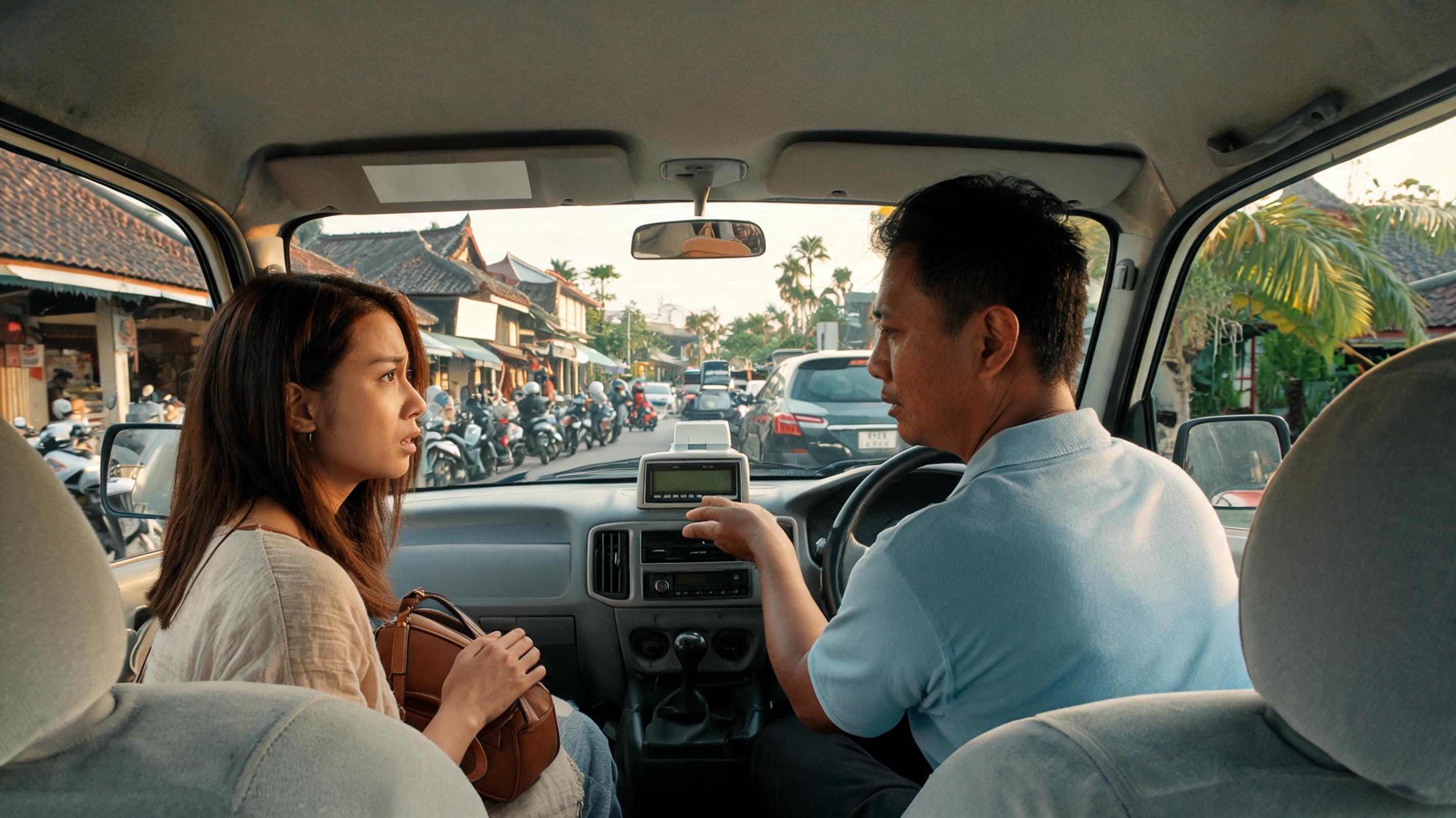
Not every factor below applies to every ride. A prearranged price may already include costs that another driver charges separately.
Traffic and waiting time
Distance alone does not tell you what a journey will cost. If your fare includes a time component, slow traffic and stationary waiting can increase the total without taking you much farther down the road.
Waiting can also happen before departure. A delayed flight, a long immigration queue or a late hotel checkout may leave a booked driver waiting beyond any included allowance. For an airport pickup, the relevant detail is when chargeable waiting begins—not simply whether the driver tracks your flight.
Extra stops and changes of destination
A direct transfer and a journey with errands are different jobs. Adding a supermarket visit, stopping for a meal or collecting someone from another hotel can add driving distance, waiting time or both.
Changing the destination matters too. A replacement hotel may sound nearby but require a different route or a longer drive. With an agreed transfer price, an itinerary change may require a revised price rather than being covered by the original arrangement.
Parking, tolls and pickup charges
Parking and road tolls can increase the amount you pay if they sit outside the agreed fare. A route using a toll road may therefore carry a separate road charge; a pickup involving paid parking may add another expense.
These are not interchangeable with a driver's service charge. If an additional amount appears at the end, establish whether it covers parking, a toll, waiting or something else. “Extras” is not a useful explanation of a bill.
Timing and vehicle requirements
Your departure time and the vehicle you need can affect the price offered before the ride begins. Late-night pickups, busy travel periods or a larger vehicle may carry different pricing, depending on the provider.
Count luggage as well as passengers. A vehicle that seats your group may not comfortably hold everyone’s suitcases, and changing vehicles at pickup can disrupt both the plan and the price.
To keep these cost drivers under control:
- Keep a direct transfer direct; treat sightseeing stops as a separate itinerary.
- Have everyone and their luggage ready at the agreed pickup time.
- Report flight, hotel or passenger changes as soon as they happen.
- Separate legitimate journey expenses from unexplained additions.
The lowest starting price is not necessarily the lowest final bill. What matters is which parts of your actual journey that price covers.
How to get a clear quote before you travel
A clear taxi quote tells you what journey you are buying, what you will pay and what remains outside the price. Before accepting a Bali taxi cost estimate, ask for those details in writing—not just a number beside a destination.
Start with the exact pickup and drop-off locations. “Airport to Ubud” leaves room for interpretation; a named accommodation and its map pin give the provider a specific journey to quote.
Send one complete journey brief
Give each provider the same information so you can compare their replies without guessing what each price covers:
- Pickup details: the location, travel date and requested pickup time. For an airport arrival, include your flight number and scheduled arrival time.
- Destination: the accommodation name, address and map pin, plus any planned stops.
- Passengers and luggage: state the number of travellers and describe your bags, including bulky items.
- Practical requirements: mention a child seat, accessibility needs or any other arrangement you need confirmed before booking.
- Journey scope: say whether you need a one-way transfer, a return booking or a driver to wait between stops.
Avoid “a few bags” or “near Seminyak.” Specific details let the provider confirm whether the proposed vehicle and booking suit your trip.
Ask for a total, not an unexplained starting price
A quote is a proposed price for a defined journey. Ask whether the figure is a fixed total for that journey or an estimate, and request the currency explicitly—preferably written as Indonesian rupiah (IDR) if that is how you will pay.
You can send this message:
Please quote for pickup at [location] on [date and time], travelling to [destination and map pin], for [passengers] with [luggage]. Please confirm the total price and currency, whether it is fixed or estimated, what is included, and anything payable separately. Please also confirm payment, cancellation and pickup arrangements.
If you are booking a return journey, ask for each leg to be identified separately. That makes it easier to check dates, pickup times and whether the quoted total covers both trips.
Confirm the booking details before paying
For an airport collection, ask where you should meet the driver, how you will identify them and whom to contact if you cannot find each other. Also ask what you should do if your flight changes.
Check when payment is due, which payment methods the provider accepts and what happens if you cancel or amend the booking. If a deposit is requested, get its amount and the remaining balance recorded in the confirmation.
Save the accepted quote, payment record and pickup instructions somewhere you can access on arrival. If the final confirmation differs from the earlier conversation, resolve that before paying or travelling; an unanswered question is not an agreed inclusion.
When repeated taxi rides make self-drive worth considering
Self-drive means renting a car and driving it yourself rather than paying for each journey with a driver. It deserves a look when your itinerary involves repeated departures, return trips and stops—not simply because one taxi fare looks expensive.
The useful comparison is your total transport cost over the same period, not a rental day against a single ride. A modest Bali taxi cost can add up across several journeys, but a rental also brings expenses and responsibilities that a passenger does not have.
Compare a realistic day, not an ambitious itinerary
Take a day you actually expect to have: leave your accommodation, visit somewhere, stop for lunch, then return after another errand or appointment. Count every separate journey, including the return leg.
Then compare the expected taxi total with the full cost of renting for that period. For self-drive, include:
- The rental charge: check the rental period, return deadline and any charge for returning late.
- Running costs: allow for fuel, parking and any tolls along your planned route.
- Contract terms: check mileage limits, permitted driving areas, insurance exclusions and your financial responsibility for damage.
- Collection and return: establish where handover happens and whether delivery or collection carries a charge.
A refundable deposit is not necessarily an expense, but it still affects the money you need available. Keep it separate from the cost comparison.
Decide whether driving helps your actual plans
Self-drive can make sense when you want control over departure times, need several stops or expect to carry belongings between destinations. Having the same vehicle available removes the need to arrange a fresh ride for each leg.
That does not make it the easier choice for every day. You still handle navigation, parking and the driving itself; renting a car does not remove time spent in traffic.
If most days involve staying near your accommodation with an occasional outing, taxis may remain the simpler arrangement. The same applies when you would rather spend the journey as a passenger, or when your plans include drinking alcohol.
Check eligibility before comparing savings
For driving in Indonesia, confirm the current licence and international driving permit requirements for your nationality and vehicle category. Check those requirements with official sources, then confirm the rental agreement and insurance conditions before committing.
There is no universal number of taxi rides that makes self-drive cheaper. Ask a prospective rental provider for a written total covering your intended dates, then compare it with the journeys you genuinely expect to take—not extra trips added to make the rental look worthwhile.
FAQ
How much should I budget for a taxi from Bali airport to Seminyak?
An illustrative budget for a prearranged transfer is IDR 150,000–300,000. Confirm the price for your exact address, pickup time, passenger count, and luggage, including any parking or waiting charges.
Is a metered taxi cheaper than booking a transfer in Bali?
It can be, especially for shorter journeys, but it is not guaranteed. Traffic affects metered fares, while a prearranged transfer offers an agreed price for a specified journey.
Can I book a fixed-price taxi before arriving in Bali?
Yes, you can arrange a fixed-price pickup with a taxi or transfer provider. Request written confirmation of the total in Indonesian rupiah, pickup instructions, waiting allowance, and cancellation terms.
Do Bali taxi quotes include tolls and airport parking?
Not necessarily. Ask the provider to confirm whether tolls, airport parking, pickup charges, and waiting time are included in the quoted total.
Is renting a car cheaper than hiring taxis every day in Bali?
It depends on your itinerary and the full rental cost. Compare your expected daily taxi spending with rental charges, fuel, parking, and insurance terms, and check that you meet Indonesia's driving requirements.


